
Nothing matches that day.
Loosen the search or try another idea.
Sturgeon Bay Ship Canal Nature Preserve
Ancient portage, sand dunes, and two lighthouse views
At 445 acres within Sturgeon Bay's city limits, this preserve protects a remarkable ridge-swale landscape, rare dune plants, and one of the region's most critical neo-tropical migratory bird stopovers — land that once narrowly escaped becoming a coal plant.
The Sturgeon Bay Ship Canal Nature Preserve sits within the city limits of Sturgeon Bay — and yet it feels like another world entirely. At 445 acres, it is one of DCLT’s largest holdings, and one of its most ecologically layered.
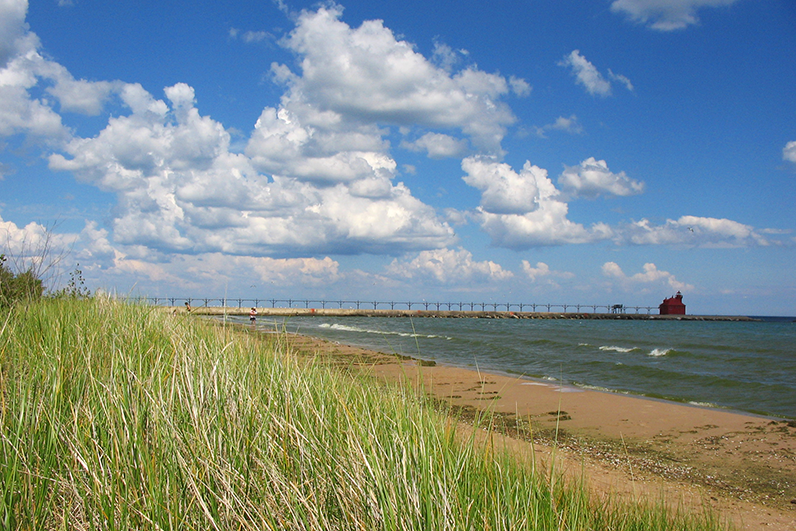
From the Lake Michigan shore, sand dunes give way to a forested ridge-swale landscape where towering white pines, hemlocks, and red maples blanket ancient shore ridges. To the west, Strawberry Creek emerges from a large cedar wetland and meanders to the waters of Sturgeon Bay. A sand ridge on the northern boundary offers magnificent views of two historic lighthouses and the entrance to the ship canal below.
This preserve has narrowly escaped a different fate more than once. In more recent history, the property was considered for large-scale development including a coal-fueled power plant and an aquatic-based industrial center. In its preserved state, it will be enjoyed by visitors and residents for generations to come.
Trails
2.5 miles of trail traverse level-to-sandy terrain through dunes, ridge forest, and wetland edges. Multiple overlooks provide views of the canal and passing ships. The trail connects to the ship canal breakwater pier for extended exploration along the water.
History
Long before the canal existed, this narrow land between Lake Michigan and Sturgeon Bay served as a heavily-travelled Native American portage route — a place where canoes were carried overland between two bodies of water. In 1872, European settlers began construction of the 7,400-foot canal that permanently linked them. Completed in 1881, the Sturgeon Bay Ship Canal shortened the shipping route between Lake Michigan and Green Bay by over 100 miles. Watch for freighters and sailboats passing through.
Wildlife & Flora
The preserve is one of the region’s most critical resting spots for migrating neo-tropical birds. Rare and threatened species including the dune thistle, dune goldenrod, and dwarf lake iris grow in the sandy habitats, while bald eagles, Caspian terns, and ospreys are regularly spotted overhead. Lake Michigan beach, ancient dune systems, mature hemlock and white pine forest, extensive wetlands, and old fields make this one of the most habitat-diverse preserves in the DCLT network.
Trail Map & Gallery
Guidelines for Visiting
- Stay on trails
- Help protect fragile habitats by staying on marked trails.
- Clean your boots
- Brush off mud and seeds before and after your visit to prevent spreading invasive species.
- Pets on leash
- Dogs are welcome on leash. Please pick up after your pet.
- No collecting
- Leave wildflowers, plants, rocks, and artifacts where you find them.
- Leave no trace
- Carry out everything you carry in.
- No motorized vehicles
- Bicycles, ATVs, and other motorized vehicles are not permitted.
- No camping or fires
- Preserves are open dawn to dusk. No overnight camping or open fires.
- Hunting season
- During hunting season, wear blaze orange on preserves with active hunting. Learn more →